Resume vs CV: What's the Difference? A Complete Guide for Job Seekers in 2026

You're about to hit "Apply" on a job that checks every box. Great salary, interesting work, solid company. Then you notice the application asks for a "CV or Resume."
And suddenly, you freeze.
Are those the same thing? Should you send that polished one-pager you've been updating for years? Or do they want the long version — every research paper, every conference, every certification you've ever earned?
If you've ever been confused by this, you're in good company. The terms get tossed around interchangeably in casual conversation, on LinkedIn posts, and even by recruiters who should know better. But the truth is: a resume and a CV serve different purposes, follow different formats, and work best in completely different situations.
Getting it wrong won't necessarily disqualify you. But getting it right signals that you understand professional norms — and that kind of awareness matters more than most people realize.
This guide will give you the full picture. No jargon, no fluff, just a clear breakdown so you never second-guess which document to send again.
What Is a Resume?
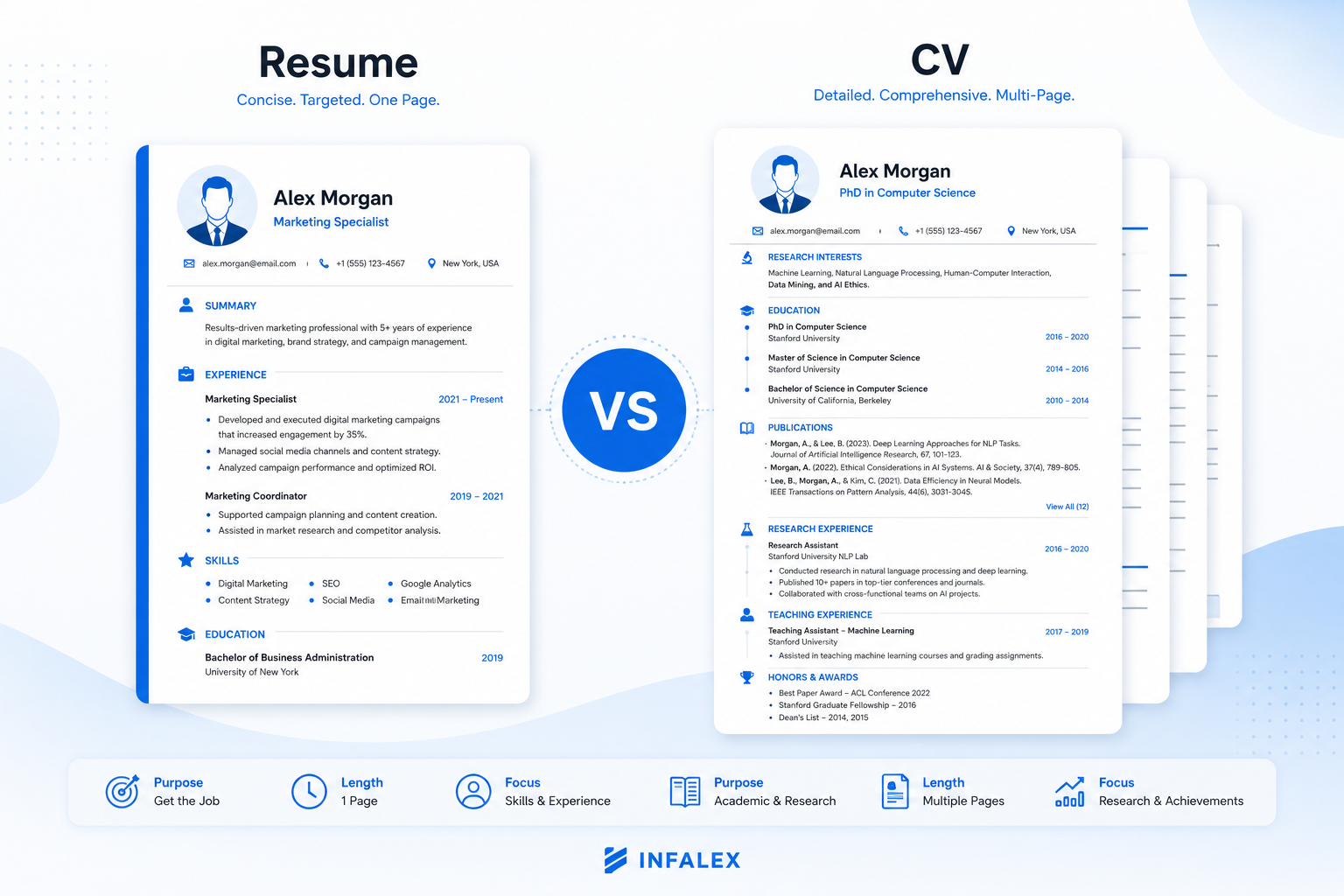
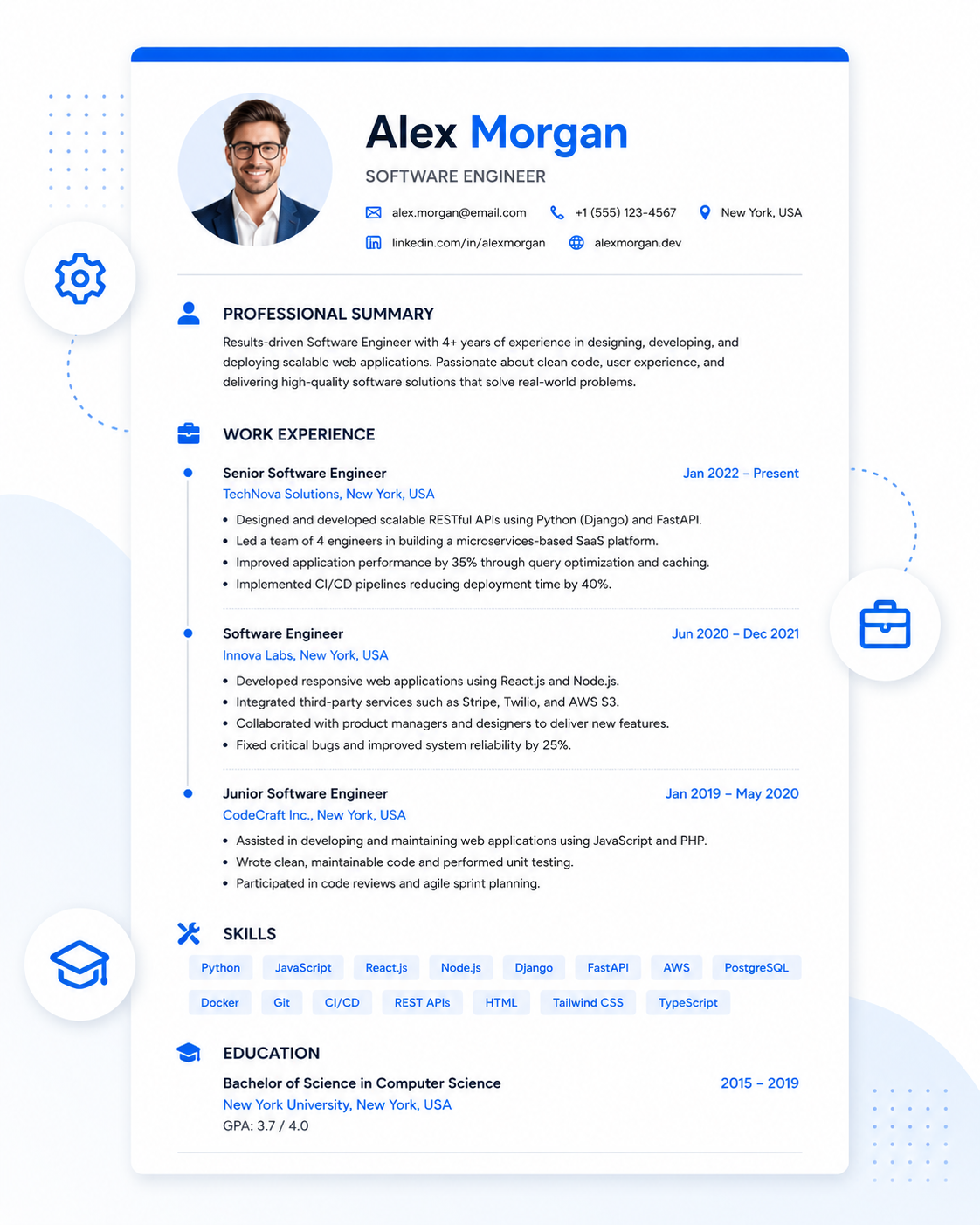
A resume is a short, focused document — usually one to two pages — designed to market your skills and experience for a specific job. The word comes from the French résumé, meaning "to summarize," and that's exactly what it does.
Think of it as a highlight reel. You're not trying to document everything you've ever done. You're selecting the experiences, skills, and achievements most relevant to the role you're targeting. A great resume answers one question in the recruiter's mind: "Can this person do this job?"
What Makes a Resume a Resume:
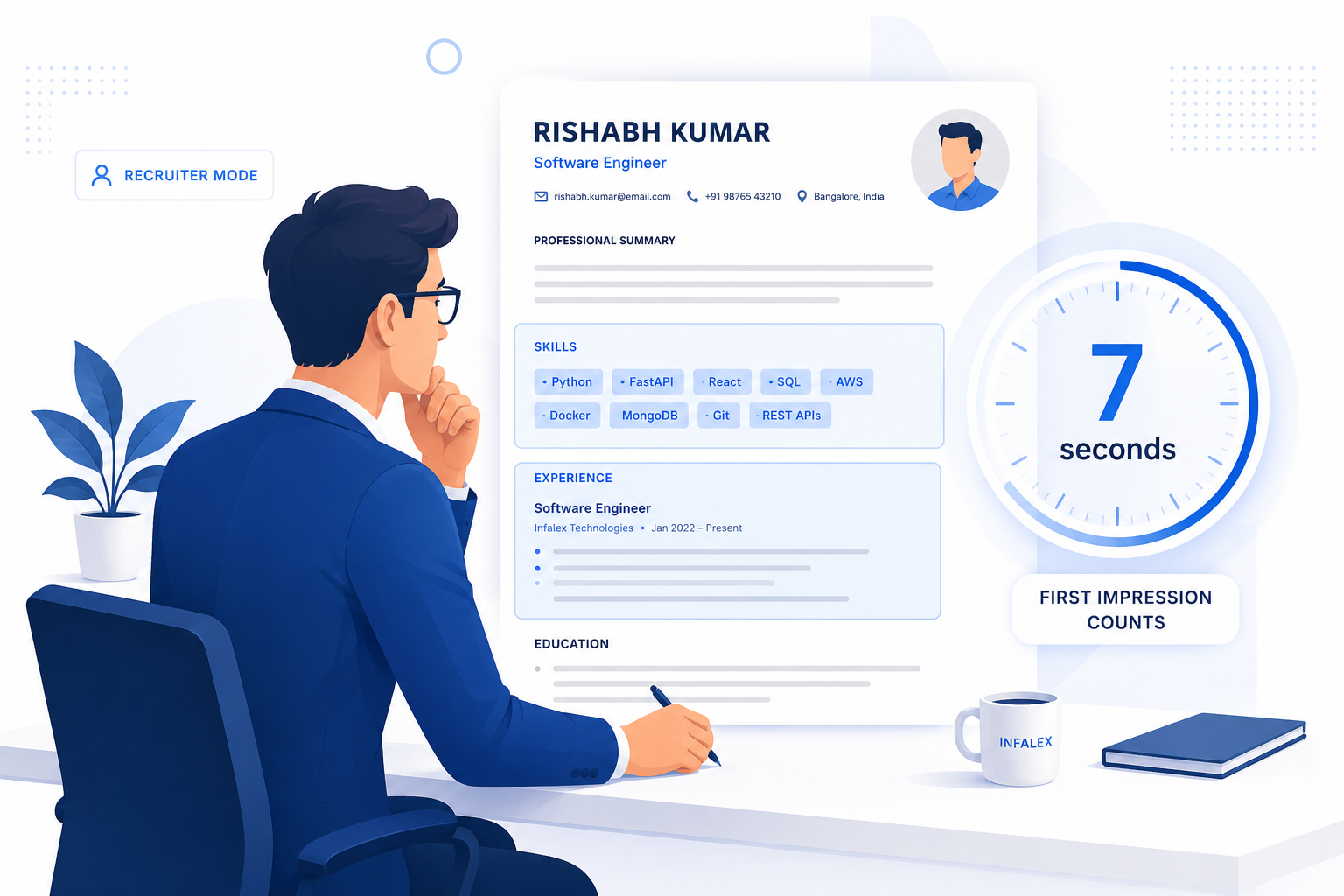
- Length: 1–2 pages. Period. Recruiters spend roughly 6–7 seconds scanning each one, so every line needs to earn its space.
- Content: Tailored for each application. You emphasize different accomplishments depending on the role.
- Structure: Reverse-chronological order is the standard. Most recent experience first, then work backward.
- Focus: Skills, quantifiable achievements, and work experience relevant to the target position.
Typical Resume Sections:
- Contact information (name, phone, email, LinkedIn)
- Professional summary (2–3 sentences positioning your value)
- Work experience (achievements over duties — always)
- Skills (technical and soft, matching the job description)
- Education (degree, institution, graduation year)
If you're a fresher with limited work experience, you'll lean more heavily on projects, internships, and relevant coursework. We cover this in detail in our guide for BCA students, but the principle applies to any entry-level candidate.
What Is a CV (Curriculum Vitae)?
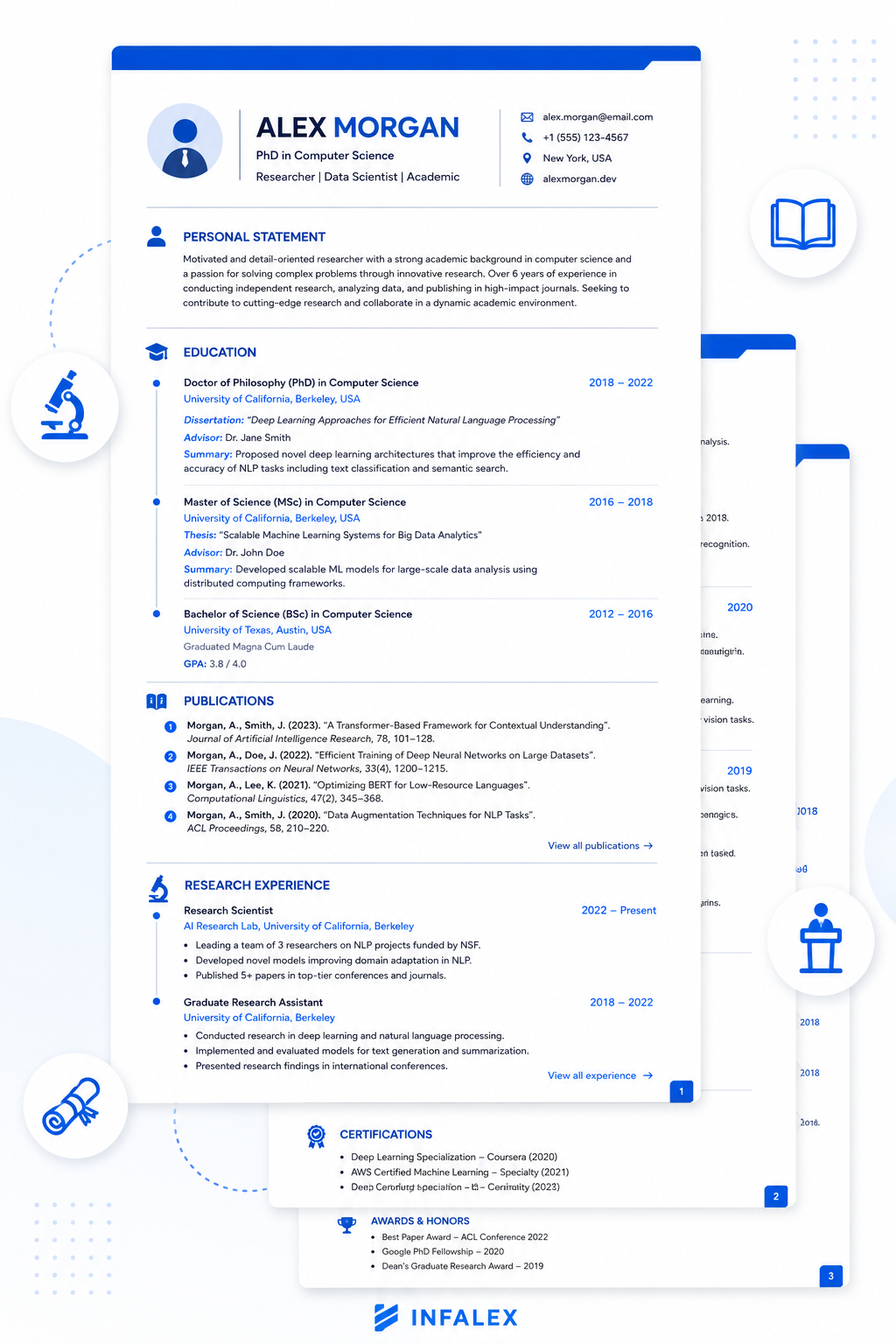
A Curriculum Vitae — Latin for "course of life" — is a comprehensive document that chronicles your entire academic and professional career. Unlike a resume, which is selective, a CV is exhaustive. It grows with you over time and can run anywhere from two pages to ten or more.
A CV is your scholarly record. It's built for fields where your publication history, research contributions, teaching portfolio, and academic credentials matter more than a snappy summary of your last three jobs.
What Makes a CV a CV:
- Length: No limit. Three pages is common for early-career academics; senior professors and researchers can easily hit 10+ pages.
- Content: Comprehensive and largely static. You add to it as your career progresses but rarely remove anything.
- Structure: Organized by category (publications, presentations, grants) rather than by date alone.
- Focus: Education, research, publications, awards, fellowships, teaching experience, and professional memberships.
Typical CV Sections:
- Contact information and research interests
- Education (including dissertation title and advisors)
- Academic appointments and teaching experience
- Research experience and lab affiliations
- Publications (peer-reviewed articles, books, book chapters)
- Conference presentations and invited talks
- Grants, fellowships, and awards
- Professional memberships and service
The key difference here: a CV isn't a marketing document. It's a record. You're not persuading someone you can do the job — you're proving that you've already built a body of work in your field.
Resume vs CV: Key Differences at a Glance
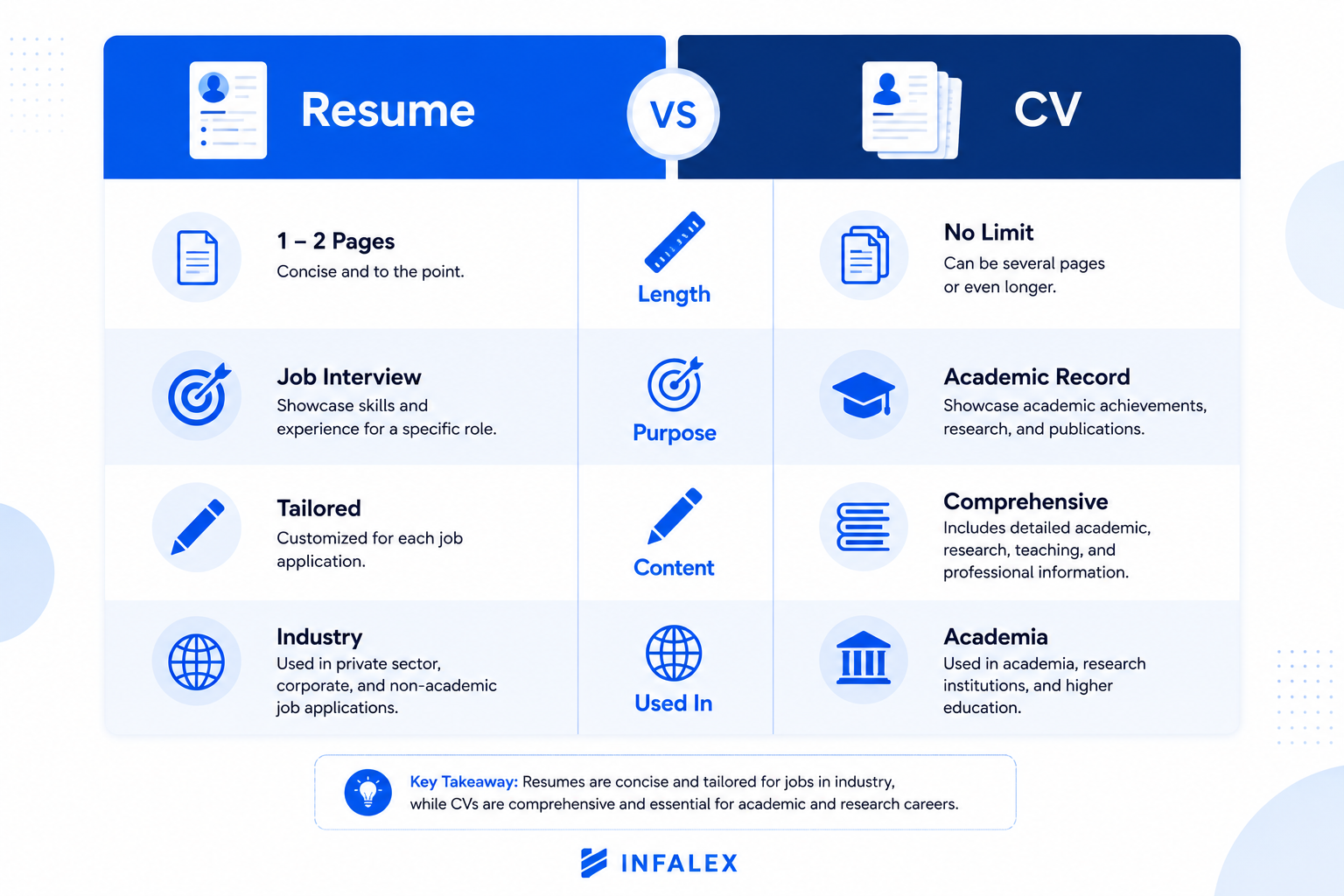
Here's where it gets concrete. These two documents differ in almost every dimension that matters:
| Feature | Resume | Curriculum Vitae (CV) | | :--- | :--- | :--- | | Length | 1–2 pages | No limit (often 3–10+ pages) | | Purpose | Get an interview for a specific job | Document your full academic record | | Content | Tailored and selective | Comprehensive and static | | Customization | Rewritten for each application | Updated periodically, rarely tailored | | Layout | Clean, scannable, flexible design | Structured, list-heavy, standardized | | Focus | Skills, achievements, work experience | Publications, research, education | | Used For | Industry, corporate, government, startups | Academia, research, medicine, science | | ATS Optimization | Highly important | Less common (but growing) |
When to Use a Resume
For the vast majority of job seekers, a resume is what you need. If any of these apply to you, reach for the resume:
- Applying for industry jobs in the US, Canada, or internationally. Corporate roles, startups, government positions, nonprofits — they all expect a concise resume.
- Changing careers. A resume lets you reshape your narrative around transferable skills, which is harder to do with a CV's rigid format.
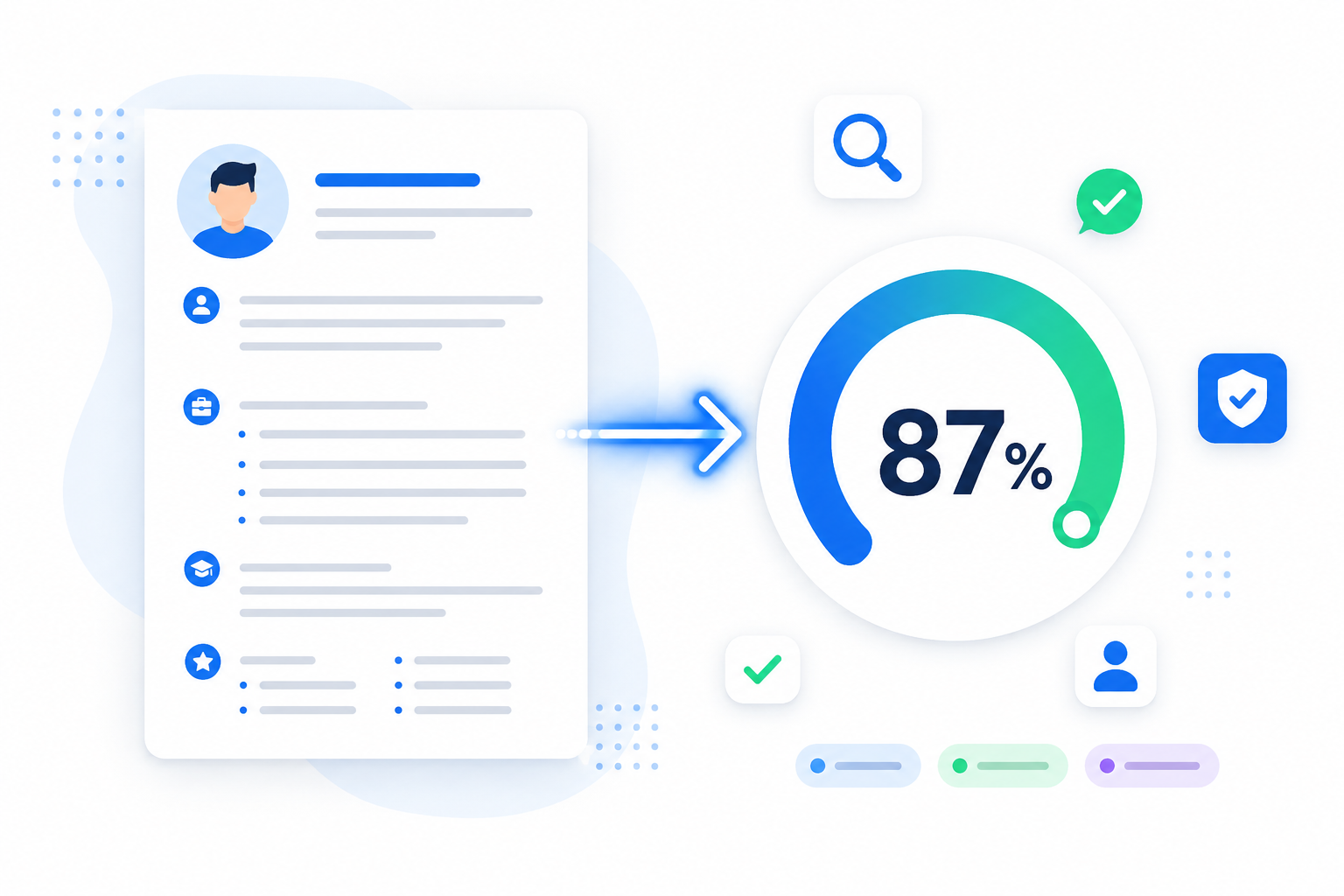
- Applying through online portals. Most Applicant Tracking Systems are designed to parse resumes. The shorter, keyword-rich format works in your favor. (Not sure how ATS scoring works? Our complete ATS score breakdown covers everything.)
- Time-sensitive applications. Recruiters reviewing 200+ applications per opening don't want to read 8 pages. They want your value proposition in 6 seconds.
Industries That Prefer Resumes:
- Technology and software engineering
- Finance and banking
- Marketing, sales, and advertising
- Consulting and management
- Retail, hospitality, and service industries
- Government (most civilian roles)
- Healthcare (non-physician roles)
When to Use a CV
A CV is the default in specific professional contexts where depth of experience and scholarly output matter more than brevity:
- Academic positions. Professor, lecturer, postdoctoral researcher, or university administrator roles almost always require a full CV.
- Research positions. Industry R&D labs, think tanks, and government research agencies want to see your complete publication and project history.
- Medical careers. Physicians, surgeons, and clinical researchers submit CVs that include residencies, board certifications, clinical trials, and publications.
- Grants, fellowships, and scholarships. These applications require a thorough record of your work, not a curated summary.
Industries That Prefer CVs:
- Higher education and academia
- Scientific research (biology, chemistry, physics)
- Medicine and clinical practice
- Law (in some jurisdictions)
- International development and policy organizations
Regional Differences You Should Know
This is where things get genuinely confusing, because the same word means different things in different countries.
United States and Canada
The distinction is clear-cut. A resume is the standard for virtually all non-academic jobs. A CV is used exclusively for academic, research, and medical positions. If a US job posting says "submit your resume/CV" and it's a corporate role, send a resume.
United Kingdom, Ireland, and Australia
In the UK, the word "CV" is used to describe what Americans call a resume — a short, 1–2 page career summary. The long academic document is typically called an "academic CV" or "full CV" to distinguish it.
Europe (Continental)
Varies by country, but many European nations use "CV" as the default term for any job application document. The Europass CV format is still common in parts of the EU, though it's becoming less popular with modern employers.
India
Both terms are used loosely. For IT, corporate, and engineering roles, employers generally expect a resume (1–2 pages). For academic and government positions, a more detailed CV is appropriate. Many Indian job seekers use "CV" to refer to their resume — the key is matching the format to the role, regardless of what you call it.
The bottom line: always research the norms for the specific country, industry, and role you're applying to. When in doubt, check the job posting carefully or email the hiring manager to ask.
Resume Length Guidelines
Getting the length right matters. Too long and recruiters lose interest. Too short and you risk leaving out critical experience.
- Freshers and early career (0–5 years): Stick to one page. Focus on projects, internships, and skills. We break this down further in our guide on how long a resume should be.
- Mid-career (5–15 years): Two pages is perfectly acceptable if every line adds value.
- Senior professionals (15+ years): Two pages is still the sweet spot. Three pages is acceptable only if you're targeting executive roles with extensive, directly relevant experience.
CV Length Guidelines
- Graduate students and early-career researchers: 2–4 pages
- Mid-career academics: 5–8 pages
- Senior professors and researchers: 8–15+ pages
There's no penalty for a long CV — as long as every entry is legitimate and organized clearly.
Common Mistakes People Make
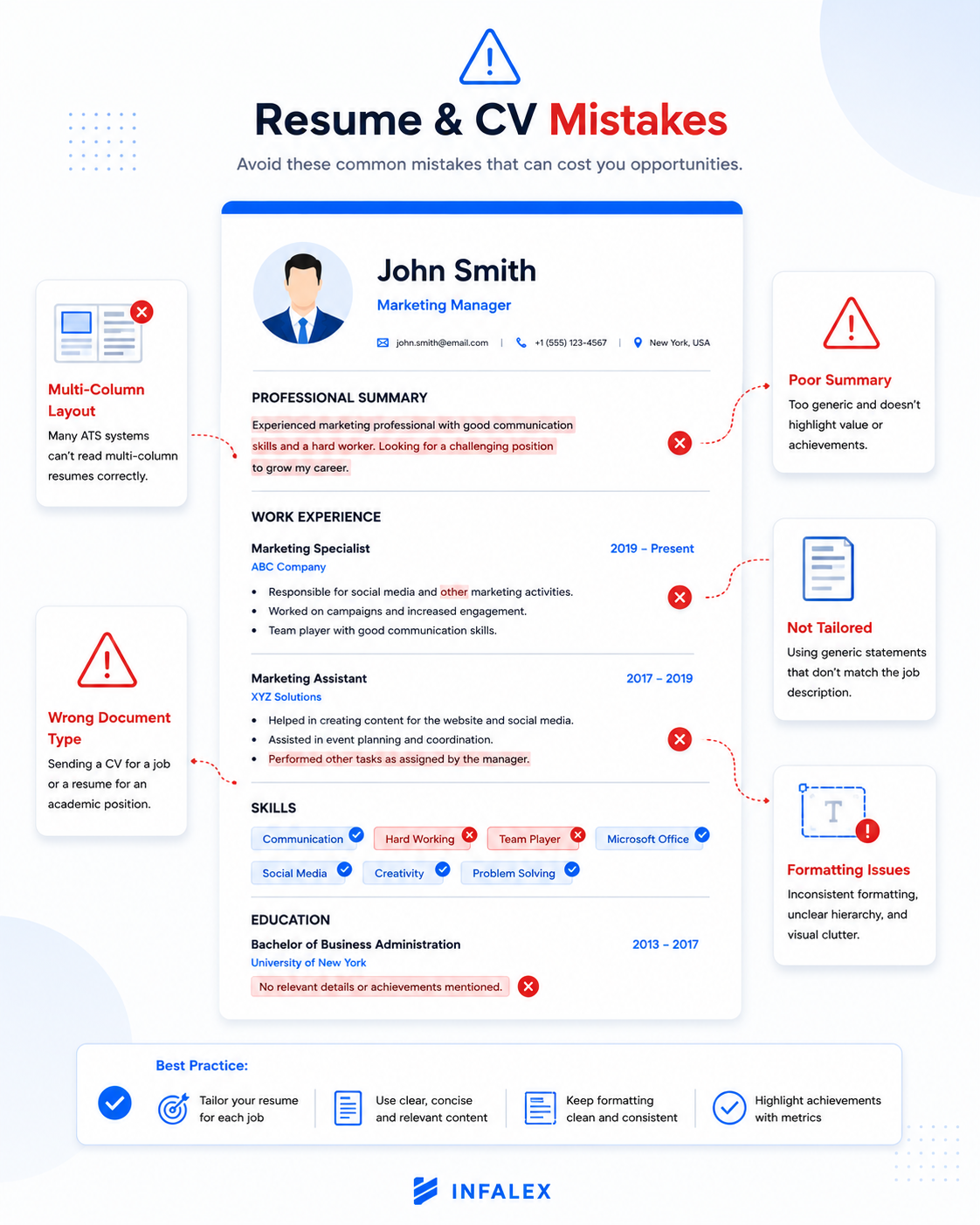
After reviewing thousands of applications, certain errors show up again and again. Here are the ones that cost people interviews:
-
Sending a CV when a resume is expected. A hiring manager at a tech startup doesn't want 8 pages of your publication history. They want a crisp summary of your skills and impact. Read the posting.
-
Sending a one-page resume for an academic role. If you're applying for a research fellowship and submit a one-page document, the selection committee will assume you have nothing to show. They need the full picture.
-
Using "CV" and "resume" interchangeably without checking regional norms. What works in London doesn't work in New York. Do your homework.
-
Not tailoring the resume for each application. A resume is not a static document. If you're sending the same version to every job, you're leaving matches on the table. This is one of the most common resume mistakes across all experience levels.
-
Ignoring ATS formatting requirements. Both resumes and CVs can be rejected by parsing software if the formatting is wrong. Multi-column layouts, text boxes, and fancy graphics are the usual culprits. Our guide on creating ATS-friendly resumes walks through the safe formatting rules step by step.
-
Including irrelevant personal information. Photos, marital status, age, and nationality are not expected on US/Canadian resumes and can actually work against you. Some countries do have different norms, but when in doubt, leave personal details out.
-
Neglecting to quantify achievements. "Managed a team" tells a recruiter almost nothing. "Led a 6-person team that shipped 3 product features ahead of schedule, reducing customer churn by 12%" tells a story.
Which One Should You Choose?
Here's a simple decision framework:
Choose a Resume if:
- You're applying for an industry job (tech, finance, marketing, etc.)
- You're in the US, Canada, or applying internationally to a corporate role
- The job posting says "resume" or "resume/CV" in a non-academic context
- You want to highlight specific, relevant skills and achievements
Choose a CV if:
- You're applying for an academic, research, or medical position
- The role is a fellowship, grant, or postdoctoral position
- You're applying in a region where "CV" means the full academic document
- The posting explicitly asks for a "curriculum vitae"
Still not sure? Ask the hiring manager. A quick email clarifying whether they prefer a resume or CV shows professionalism, not ignorance.
Tips for Creating a Professional Resume
-
Lead with a strong professional summary. Two to three sentences that position your value for the specific role. Not a generic objective statement — a targeted pitch.
-
Quantify everything you can. Revenue generated, costs saved, projects delivered, team size, percentage improvements. Numbers make your impact concrete.
-
Use strong action verbs. Start bullet points with words like "spearheaded," "optimized," "delivered," "implemented," and "reduced." Avoid passive language.
-
Tailor for each application. Read the job description. Identify the top 5 requirements. Make sure your resume directly addresses each one.
-
Keep formatting clean and ATS-safe. Single-column layout, standard fonts (Arial, Calibri, Garamond), clear section headings, no graphics or icons. Save as a text-based PDF.
-
Test before you submit. Don't guess whether your resume will pass ATS screening. Run it through Resumetra to get an instant compatibility score and pinpoint missing keywords before you hit "Apply."
Tips for Writing an Effective CV
-
Organize by category, not just chronology. Group your publications, presentations, and teaching experience into clearly labeled sections.
-
Include everything relevant — but keep it organized. A 10-page CV is fine if it's well-structured. A disorganized 4-page CV is painful to read.
-
Keep your publications list current. Update your CV every time a new paper is published, a grant is awarded, or a conference presentation is accepted.
-
Use consistent citation formatting. Pick a style (APA, MLA, Chicago) and stick with it throughout your entire publications section.
-
Add a research statement or personal statement at the top. This gives the reader context for the detailed record that follows.
-
Proofread everything. In academia, attention to detail is non-negotiable. A typo in a CV undermines your credibility in ways it might not on a resume.
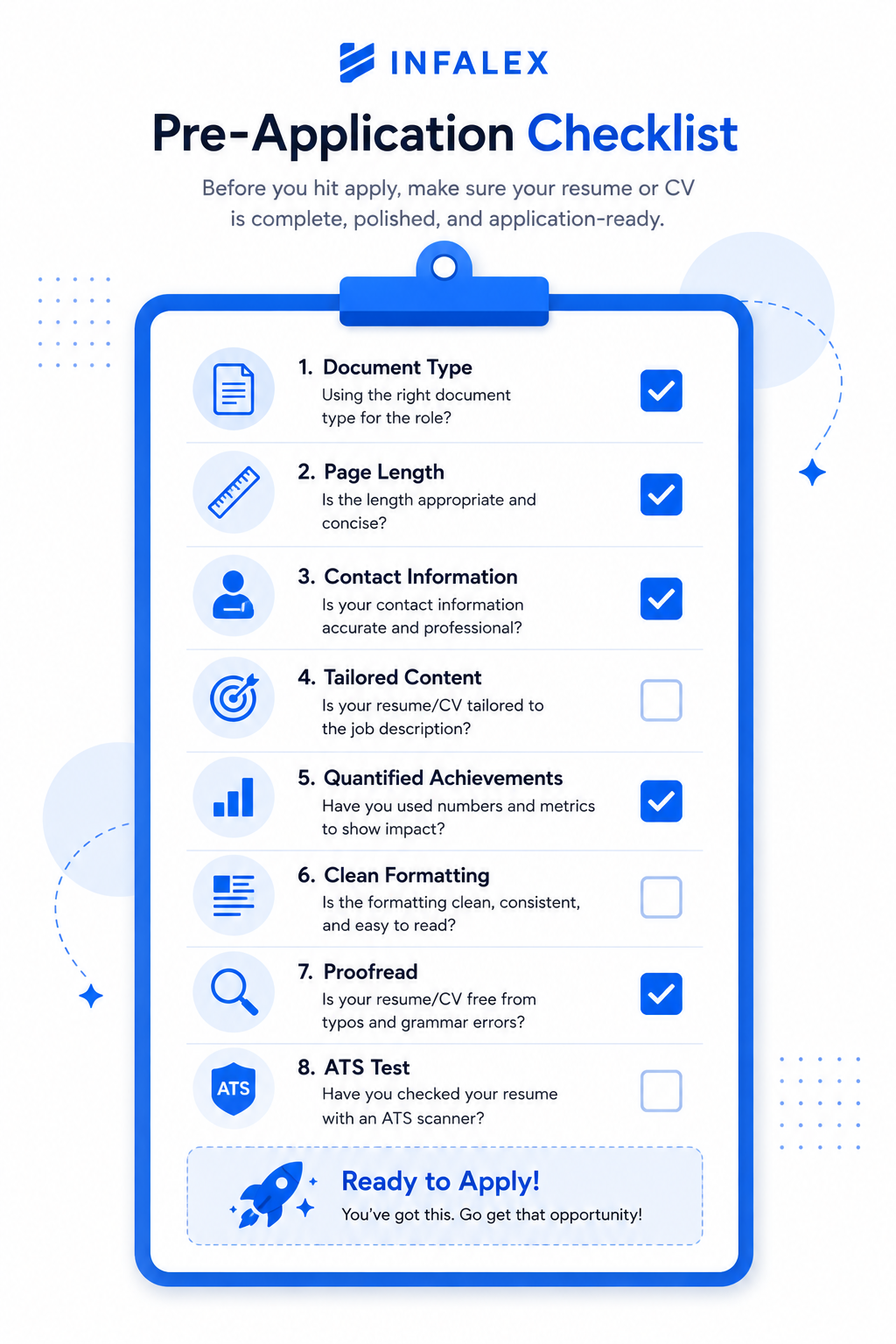
Final Checklist Before Applying
Run through this before you submit anything:
- ⬜ You've confirmed whether the role requires a resume or a CV
- ⬜ Your document matches the expected format for the country and industry
- ⬜ Your resume is 1–2 pages (or your CV is comprehensive and well-organized)
- ⬜ Contact information is accurate and professional
- ⬜ You've tailored the content for this specific role
- ⬜ Achievements are quantified with numbers and data
- ⬜ Formatting is clean, consistent, and ATS-compatible
- ⬜ You've proofread for spelling, grammar, and consistency
- ⬜ File is saved as a text-based PDF (unless DOCX is specifically requested)
- ⬜ You've tested your resume with Resumetra for ATS compatibility
💡 Infalex Insight:
Whether you're sending a targeted resume or a detailed CV, one thing stays the same: if the document can't get past the ATS, nobody reads it. Resumetra lets you upload your resume, paste the job description you're targeting, and get an instant ATS compatibility score — complete with keyword gap analysis and formatting checks. You'll know exactly where you stand before you click "Submit." Stop guessing. Start optimizing.
🔗 Keep Optimizing Your Job Search with Infalex
If this guide clarified the resume vs CV question, these related articles will take your application strategy even further:
What Is an ATS Score? Everything You Need to Know — Understand the scoring system that determines whether recruiters ever see your resume.
How to Create an ATS-Friendly Resume That Actually Gets Interviews — The complete formatting and keyword framework for passing every ATS scan.
Top 25 Resume Mistakes That Get You Rejected Instantly — A comprehensive deep-dive into the errors that cost you interviews, with fixes for each one.
Cracking the Code: Top Resume Keywords Recruiters Look for in 2026 — Discover the exact words and phrases that ATS algorithms and human recruiters prioritize.
How Long Should a Resume Be? The Definitive Guide (2026) — Finally settle the one-page vs. two-page debate with data-driven recommendations.
Best Resume Format for BCA Students in India (2026 Guide) — A specialized guide with real examples for BCA graduates entering the IT job market.
Frequently Asked Questions (FAQs)
Q: What is the main difference between a resume and a CV?
A: A resume is a concise 1–2 page document tailored for a specific job, focusing on relevant skills and achievements. A CV (Curriculum Vitae) is a comprehensive record of your entire academic and professional history — including publications, research, and awards — with no page limit. The resume is a marketing tool; the CV is a scholarly record.
Q: Can I use a CV instead of a resume for a corporate job?
A: In the US and Canada, no. Sending a multi-page academic CV for a corporate or tech role signals that you don't understand the industry's expectations. For non-academic jobs, always send a tailored resume. In the UK and parts of Europe, the term "CV" refers to the short career summary (equivalent to a US resume), so context matters.
Q: How long should a resume be compared to a CV?
A: A resume should be one page for candidates with under 10 years of experience and a maximum of two pages for senior professionals. A CV has no page limit and typically ranges from 2 pages (early-career academics) to 10+ pages for senior researchers with extensive publication records.
Q: Does region affect whether I should send a resume or CV?
A: Absolutely. In the US and Canada, "resume" and "CV" have distinct meanings — resumes for industry, CVs for academia. In the UK, Ireland, and Australia, "CV" is commonly used to mean a short career summary. In India, both terms are used loosely, but format expectations depend on the industry. Always research the norms for your target country and role.
Q: Do Applicant Tracking Systems treat resumes and CVs differently?
A: ATS software scans both document types for keywords and formatting. However, resumes — because they're shorter and tailored to specific job descriptions — tend to be easier to optimize for ATS matching. Regardless of which document you submit, clean formatting and relevant keywords are essential. You can check your compatibility score with Resumetra before applying.
Q: Is a CV just a longer resume?
A: Not exactly. A longer resume is still a resume — just a poorly edited one. A CV is a fundamentally different document with a different purpose, structure, and audience. Resumes are selective summaries tailored to specific roles. CVs are comprehensive records that grow throughout your career. The length difference is a consequence of their different goals, not the defining feature.
Q: What should freshers and students submit — a resume or a CV?
A: For almost all entry-level industry roles (tech, business, marketing, etc.), freshers should submit a one-page resume focused on skills, projects, and internships. The only exception is if you're applying for a research assistantship, academic position, or fellowship — then a CV is appropriate even at the early-career stage.
Q: When is it okay to ask the employer which one they want?
A: Always. If the job posting is ambiguous — for example, it says "submit your CV/Resume" — it's perfectly professional to email the hiring manager or recruiter and ask which format they prefer. This shows attention to detail, not lack of knowledge.
Ready to optimize your career?
Join thousands of professionals using Infalex Resumetra to craft ATS-optimized resumes and land more interviews.