What Is an ATS Score? Everything You Need to Know to Beat the Bots and Land Interviews

You just applied to your dream job. Your resume was polished, your experience matched the requirements, and you hit "Submit" feeling confident.
Two weeks later? Nothing. No call, no email, no rejection notice. Just silence.
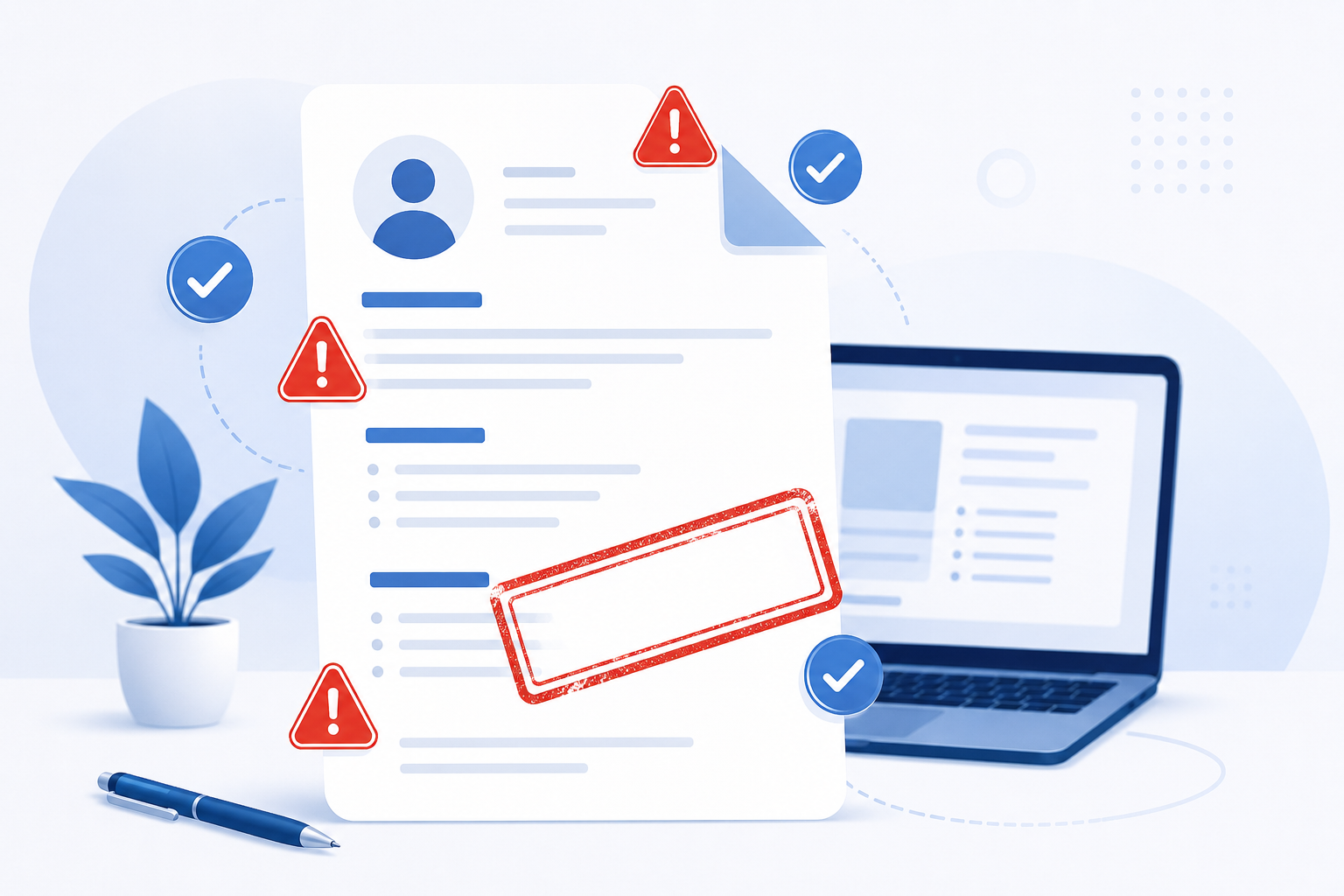
Here's what probably happened: your resume never made it past the software. Before a recruiter saw your name, an Applicant Tracking System scanned your document, assigned it a score, and ranked it against hundreds of other applicants. If that score was too low, your application was effectively invisible.
Over 90% of Fortune 500 companies use an ATS to screen resumes. And studies suggest that up to 75% of qualified candidates get filtered out before a human being reads a single line.
The concept at the center of this entire process? Your ATS score.
This guide breaks down everything you need to know — what an ATS score actually is, how it's calculated, what counts as a "good" score, and exactly how to improve yours before you apply to another job.
Why ATS Scores Matter in Modern Hiring
Let's start with a reality check. The days of printing a resume on thick paper and handing it to a receptionist are long gone. Today, hiring is digital, automated, and brutally competitive.
When a company posts a single job opening on LinkedIn or Indeed, they might receive 250 to 1,000+ applications within the first week. No recruiter on earth can manually read every single one. That's where ATS software steps in — and where your ATS score becomes the invisible factor that determines whether you get an interview or get ghosted.
Why Many Qualified Candidates Never Hear Back
It's not always about your qualifications. Many job seekers who are genuinely qualified for a role never receive a callback. The reason? Their resume wasn't optimized for the machine that reads it first.
Common scenarios include:
- A software engineer with 5 years of Python experience who used "programming" instead of "Python" in their skills section
- A marketing manager whose beautiful Canva resume was completely unreadable to the ATS parser
- A project manager who listed "led cross-functional teams" when the job description specifically said "stakeholder management"
In each case, the human behind the resume was qualified. The document, however, didn't speak the machine's language.
Common Misconceptions About ATS Scores
Before we go deeper, let's clear up some confusion:
- "ATS automatically rejects everyone." Not exactly. Most ATS platforms rank and filter — they don't send rejection emails on their own. Low-scoring resumes simply never surface to the recruiter.
- "If my score is high enough, I'll definitely get an interview." A high score gets your resume seen, but the recruiter still makes the final call.
- "ATS is only used by big companies." In 2026, companies of all sizes use ATS. Even startups with 50 employees rely on tools like Greenhouse, Lever, or Workable.
What Is an ATS Score?
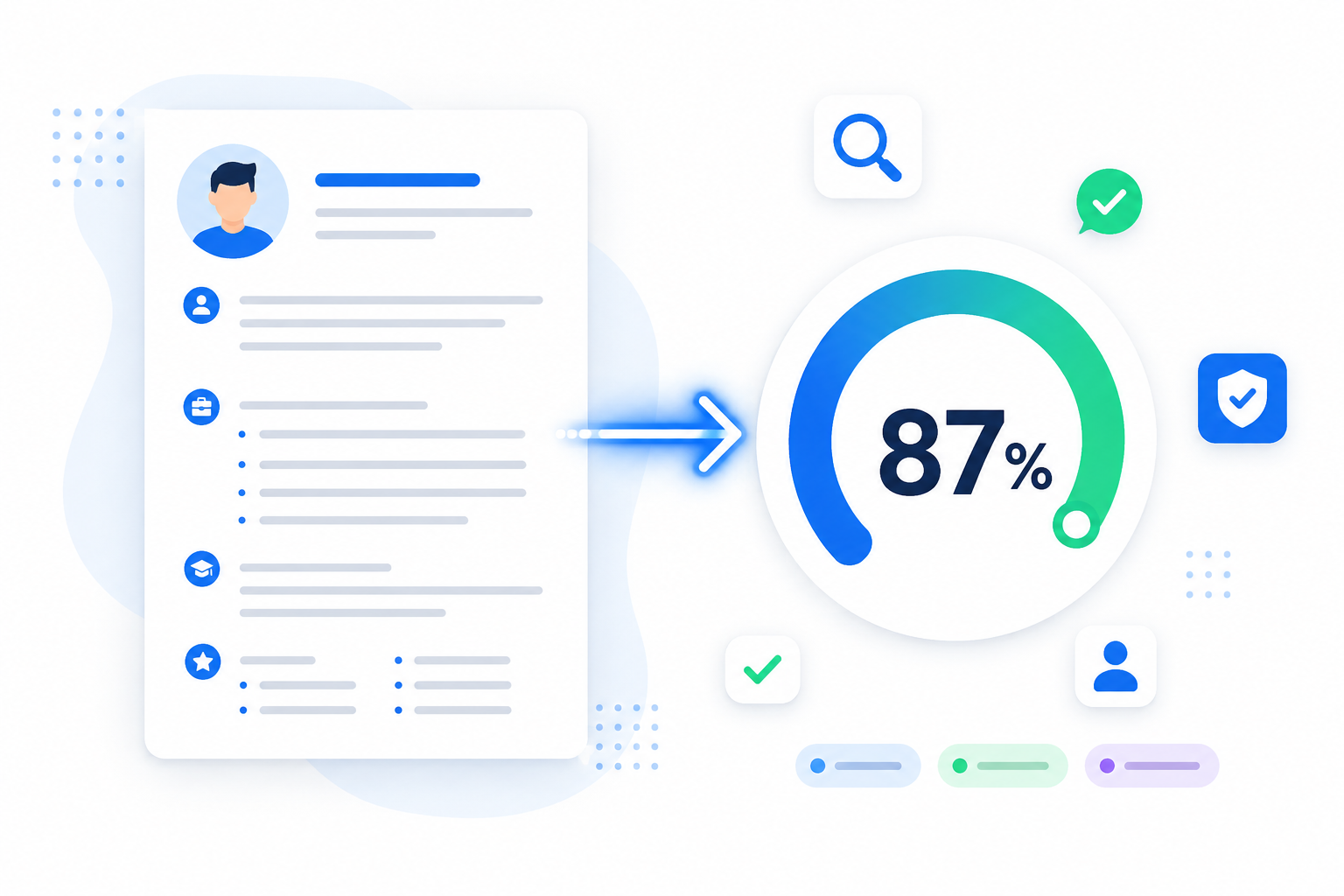
An ATS score (sometimes called a resume match score or compatibility score) is a numerical ranking that indicates how closely your resume aligns with a specific job description.
Think of it like a search engine ranking. When a recruiter searches for candidates inside their ATS, the system retrieves the resumes that best match the job's requirements — and your score determines where you land in that ranking.
How It Works in Practice
Here's the typical flow:
- You submit your resume through a company's career portal
- The ATS parses your document — extracting text and categorizing it into fields (name, experience, education, skills)
- The system compares your content against the job description's keywords, required qualifications, and preferred skills
- A relevance score is generated, and your resume is ranked against other applicants
- A recruiter opens the ATS dashboard and reviews candidates from highest to lowest score
Does ATS Actually Give a "Score"?
Here's an important nuance: not every ATS displays a literal percentage score. Some systems (like Workday or Taleo) rank candidates without showing an explicit number. Others (like Greenhouse or Lever) provide match scores or star ratings that recruiters can filter by.
The concept of a "score" is real, but the format varies by platform. What doesn't change is the underlying process: your resume is algorithmically compared to the job description, and better matches rise to the top.
ATS Parsing vs. Resume Scoring
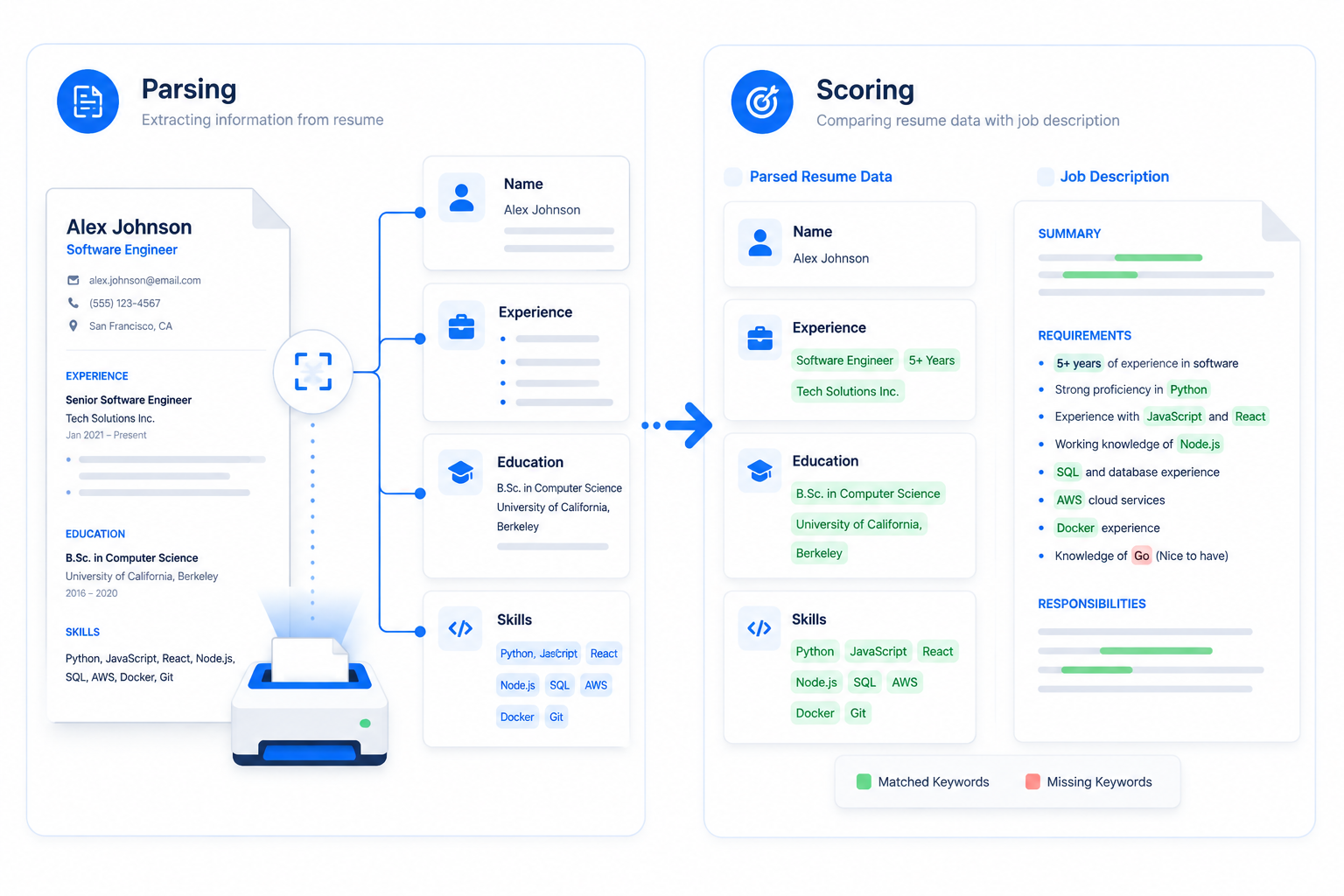
These are two different (but related) processes:
- Parsing is when the ATS extracts raw text from your document and categorizes it into structured fields. If parsing fails (due to bad formatting, graphics, or unusual layouts), your data gets scrambled — and your score drops.
- Scoring is when the parsed data is compared against the job description to determine relevance. Even a perfectly parsed resume can receive a low score if it lacks the right keywords.
Both steps matter. A resume that parses cleanly but misses keywords will score low. A keyword-rich resume with broken formatting may not parse at all.
What Is an Applicant Tracking System (ATS)?
An Applicant Tracking System is enterprise software that companies use to manage the entire recruitment process — from posting job openings to screening applicants to scheduling interviews.
What ATS Software Actually Does
At its core, an ATS serves as a centralized database for all job applications. But modern ATS platforms do far more than store resumes:
- Resume parsing: Automatically extracts and categorizes text from uploaded documents
- Keyword matching: Compares candidate profiles against job requirements
- Candidate ranking: Sorts applicants by relevance score so recruiters can prioritize
- Workflow automation: Manages interview scheduling, email templates, and status tracking
- Compliance tracking: Maintains records for legal and diversity reporting
Why Companies Use ATS
The answer is simple: volume. A mid-size company hiring for 20 open roles might receive 5,000+ applications per month. Without automated screening, recruiters would spend their entire day just reading resumes — and still miss qualified candidates.
ATS software saves time, reduces bias in initial screening (when configured properly), and ensures that no application falls through the cracks.
How Your Resume Gets Processed
When you click "Apply," here's what happens behind the scenes:
- Upload: Your file (PDF or DOCX) enters the ATS
- Text extraction: The system strips away formatting and pulls out raw text
- Field mapping: Your name, contact info, work history, education, and skills are mapped into structured database fields
- Keyword indexing: Every word on your resume is indexed for searchability
- Score calculation: Your indexed content is compared against the job description
- Ranking: You're placed in a ranked list alongside all other applicants
- Recruiter review: The recruiter opens the top-ranked profiles and decides who moves forward
If the ATS scrambles your data at step 3 or can't extract your text at step 2, steps 4 through 7 become meaningless.
How ATS Scores Are Calculated
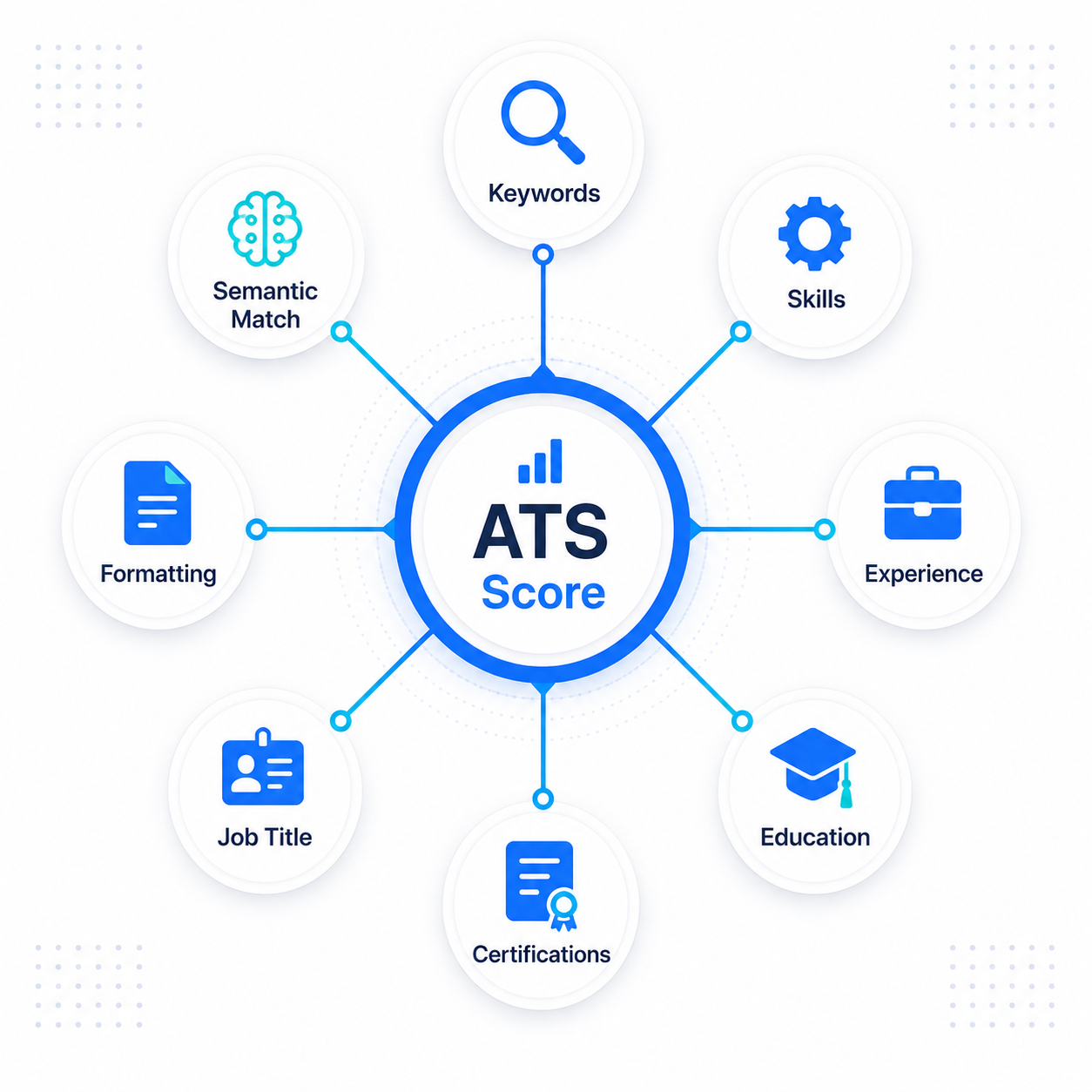
Every ATS uses a different algorithm, so there's no single universal formula. However, most scoring systems consider the same core factors:
Keyword Relevance
This is the biggest factor. The ATS checks whether your resume contains the specific skills, tools, certifications, and qualifications mentioned in the job description.
"Managed social media accounts and improved engagement"
vs.
"Developed and executed social media marketing strategies using Hootsuite, increasing audience engagement by 45% over 6 months"
The second version matches more keywords naturally: "social media marketing," "Hootsuite," "engagement," "strategies."
Skills Matching
The system looks for both hard skills (Python, SQL, Figma, Google Analytics) and soft skills (leadership, communication, project management). Hard skills typically carry more weight because they're easier to verify.
Experience Alignment
Does your job history reflect the seniority level and responsibilities described in the posting? A job asking for "5+ years of product management experience" will rank candidates who clearly demonstrate that timeline.
Education and Certifications
If the job requires a specific degree or certification (PMP, AWS Certified, CPA), the ATS checks for exact matches. Missing a required certification can significantly lower your score.
Job Title Relevance
If the posting is for a "Data Analyst" and your resume lists your role as "Business Intelligence Specialist," some ATS platforms won't make the connection unless both terms appear in your document.
Resume Formatting
Clean, single-column formatting with standard section headings helps the parser extract your data accurately. Complex layouts with tables, text boxes, and multi-column designs confuse the parser and lower your score indirectly.
Semantic and Contextual Matching
Modern ATS platforms powered by AI go beyond exact keyword matching. They understand that "machine learning" and "ML" refer to the same concept, or that "led a team of 12" implies leadership experience. These systems analyze context — not just individual words.
AI-Powered Ranking vs. Traditional ATS
Older ATS platforms rely primarily on exact keyword matching. Newer AI-powered systems (used by companies like Google, Amazon, and Microsoft) analyze semantic meaning, career progression, and even the quality of your achievements. The gap between these two approaches is widening every year.
What Is a Good ATS Score?
Most resume scanning tools and ATS platforms use a percentage-based scoring system. Here's a general guideline:
- 90–100%: Excellent match. Your resume is highly aligned with the job description. You're likely to appear at the top of the recruiter's list.
- 75–89%: Strong match. You have most of the required qualifications and keywords. Solid interview chances.
- 50–74%: Moderate match. You're missing some key terms or qualifications. May or may not surface to the recruiter, depending on competition.
- Below 50%: Weak match. Your resume likely won't be reviewed unless the applicant pool is very small.
When a High Score Can Still Fail
A score of 85% doesn't guarantee anything. If 200 other candidates also scored 85% or higher, the recruiter still has to choose. Your score gets you in the door — your content, achievements, and professional story close the deal.
Why 100% Isn't Always the Goal
Chasing a perfect score can lead to unnatural keyword stuffing, which hurts readability. A recruiter who opens a 95% match resume and finds robotic, keyword-heavy language will move on to the next candidate. The goal is to score high enough to be seen, while writing well enough to be chosen.
The Human Factor
ATS scoring is just the first filter. After passing the machine, your resume still needs to impress a human. That means clear writing, quantified achievements, logical flow, and a professional tone matter just as much as keyword density.
Why ATS Scores Matter
Understanding and optimizing your ATS score gives you a measurable edge in every job application:
- Higher interview chances: A well-optimized resume consistently surfaces at the top of recruiter searches
- Better recruiter visibility: Even passive candidates in ATS databases benefit from higher relevance scores when recruiters search for talent
- Faster screening: Recruiters trust ATS rankings — a high score means less time proving your fit
- Improved keyword matching: Optimizing your score forces you to align your resume with the specific language recruiters use
- Increased confidence: Knowing your score before you apply removes the guesswork and anxiety from the job search
Why Your ATS Score May Be Low
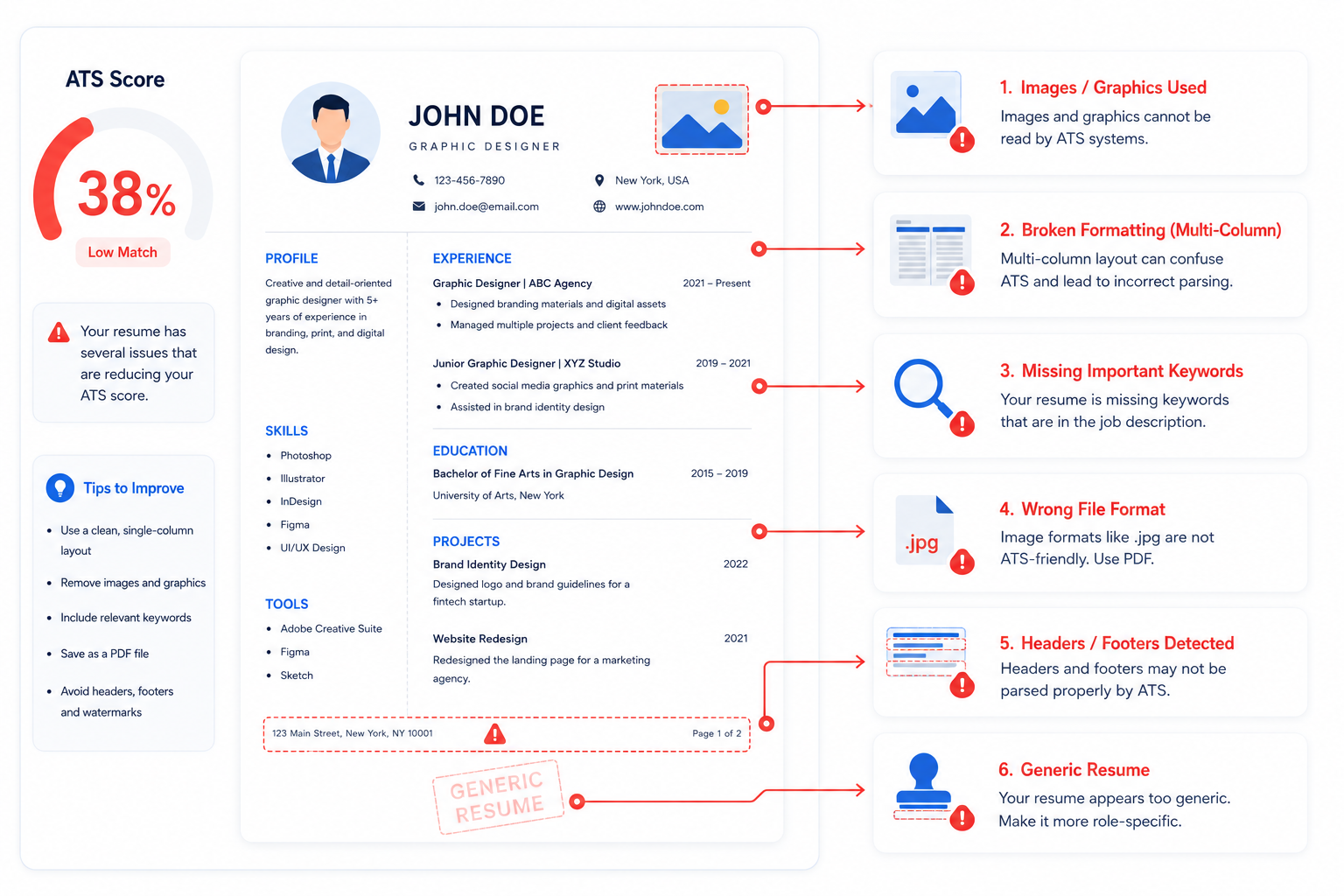
If you've been applying consistently without callbacks, one or more of these issues is probably dragging your score down:
- Missing keywords: Your resume doesn't contain the exact terms from the job description
- Wrong formatting: Multi-column layouts, text boxes, or tables that the parser can't read
- Graphics and images: Skill bars, icons, logos, and headshots that ATS treats as blank space
- Headers and footers: Contact information placed in document headers/footers that many ATS systems skip entirely
- Poor section names: Creative headings like "My Journey" instead of standard labels like "Work Experience"
- Generic resume: The same untailored document sent to every job
- Irrelevant experience: Bullet points that don't connect to the target role's requirements
- Inconsistent job titles: Using different title formats throughout your resume
- Unsupported file formats: Submitting .pages, .jpg, or flattened image PDFs
- Keyword stuffing: Cramming in keywords unnaturally, which modern AI-powered ATS can detect and penalize
- Poor readability: Dense paragraphs and walls of text with no bullet points or clear structure
How to Improve Your ATS Score
Here's the practical playbook. Follow these steps before your next application:
1. Tailor Every Resume
Never send the same resume twice. Customize your professional summary, skills section, and top bullet points for each job. Even 15 minutes of tailoring can dramatically improve your match score.
2. Analyze the Job Description
Read the posting carefully and highlight every skill, tool, qualification, and responsibility mentioned. These are your target keywords.
3. Use Relevant Skills Naturally
Don't just list keywords in a block at the bottom. Weave them into your experience bullets to show context.
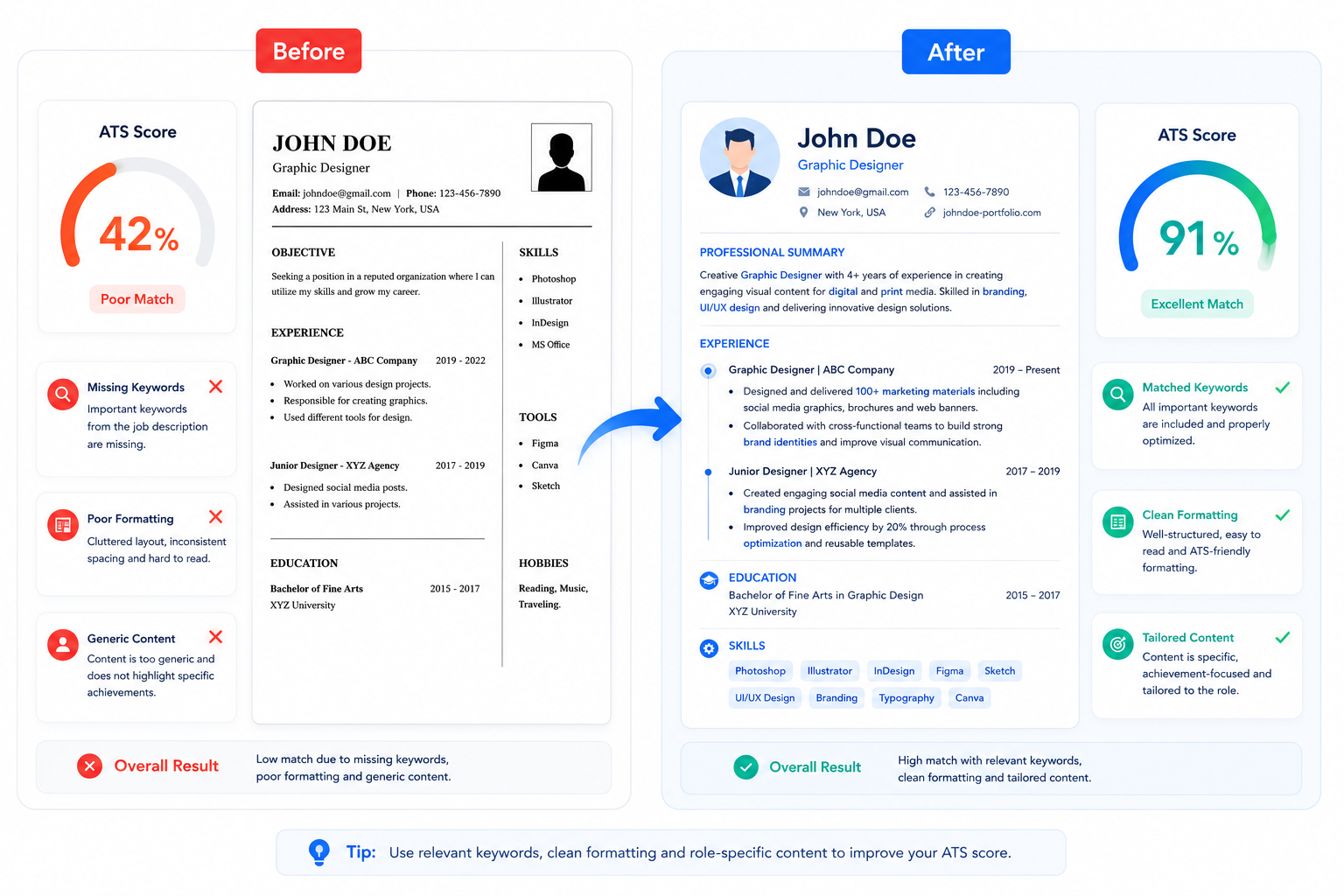
Before:
"Experienced in various marketing activities and campaigns"
After:
"Planned and executed 12 email marketing campaigns using Mailchimp, achieving an average open rate of 28% and driving $45K in quarterly revenue"
4. Match Recruiter Terminology
If the job says "stakeholder management," use that exact phrase — not "working with different teams." Mirror the language of the posting.
5. Quantify Achievements
Numbers catch both ATS algorithms and human eyes.
Before:
"Improved team performance"
After:
"Increased team productivity by 30% through implementing weekly sprint reviews and automated testing workflows"
6. Optimize Section Order
Place your most relevant sections (Professional Summary, Skills, Work Experience) at the top. Education and certifications can follow after.
7. Choose ATS-Friendly Fonts
Stick to standard fonts: Arial, Calibri, Helvetica, Times New Roman, or Georgia. Avoid decorative or script fonts.
8. Keep Formatting Simple
Use a single-column layout with clear headings. Avoid tables, text boxes, columns, and embedded graphics.
9. Remove Unnecessary Graphics
Skill progress bars, profile photos, company logos, and decorative icons all look like blank space to an ATS.
10. Use Proper File Formats
Save as a text-based PDF (not a flattened image PDF). If the posting specifically requests DOCX, submit that instead.
11. Improve Readability
Use short bullet points starting with strong action verbs. Break dense paragraphs into scannable lists.
12. Proofread Carefully
Misspelled keywords won't match. "Pyhton" doesn't equal "Python" in an ATS database.
ATS Score Myths — Debunked
Let's separate fact from fiction:
Myth: "ATS automatically rejects resumes." Reality: Most ATS platforms rank and filter — they don't send rejection emails. A low-ranking resume simply never appears in the recruiter's view. Some systems do have "knockout questions" that auto-reject, but the resume itself isn't "rejected" in the way most people imagine.
Myth: "A higher score guarantees interviews." Reality: A high score gets you seen by the recruiter. The recruiter then evaluates your actual experience, writing quality, and career story before deciding. ATS score is a gate, not a guarantee.
Myth: "White text keyword stuffing works." Reality: This trick — hiding keywords in white text so only the ATS reads them — used to work years ago. Modern ATS platforms detect hidden text, and many will flag or penalize resumes that use it. Don't risk it.
Myth: "Fancy designs improve ATS performance." Reality: The opposite is true. Graphic-heavy templates from Canva or similar tools often break ATS parsing entirely. A clean, simple layout always outperforms a visually stunning one when it comes to ATS compatibility.
Myth: "One resume works for every application." Reality: Every job description uses different keywords and emphasizes different skills. A resume that scores 90% for one role might score 55% for a similar role at a different company. Tailoring is essential.
Myth: "ATS only checks keywords." Reality: Modern AI-powered ATS systems analyze context, career progression, skill relevance, and even the quality of achievement statements. Keywords still matter, but they're only one piece of the puzzle.
How to Check Your ATS Score
You don't have to guess how your resume performs. Several types of tools can help:
Resume Scanners
These tools parse your resume and compare it against a job description, showing you which keywords match and which are missing. They simulate how an ATS reads your document.
AI Resume Checkers
More advanced than basic scanners, AI resume checkers analyze semantic relevance, formatting compatibility, section structure, and skill gaps. They provide actionable recommendations — not just a number.
Resume Optimization Tools
The best tools combine scanning, analysis, and optimization suggestions in one workflow. Upload your resume, paste the target job description, and get a complete breakdown of what to fix.
Why Resumetra Stands Out
Resumetra is built specifically for this purpose. It acts like an enterprise ATS, giving you an instant compatibility score, highlighting missing keywords, identifying formatting issues, and showing exactly where your resume falls short. You see what the machine sees — before you submit.
Continuous Optimization
Don't just check your score once. Run your resume through a scanner for every new application. Job descriptions vary, and a resume optimized for one role may need adjustments for the next.
ATS Score Checklist
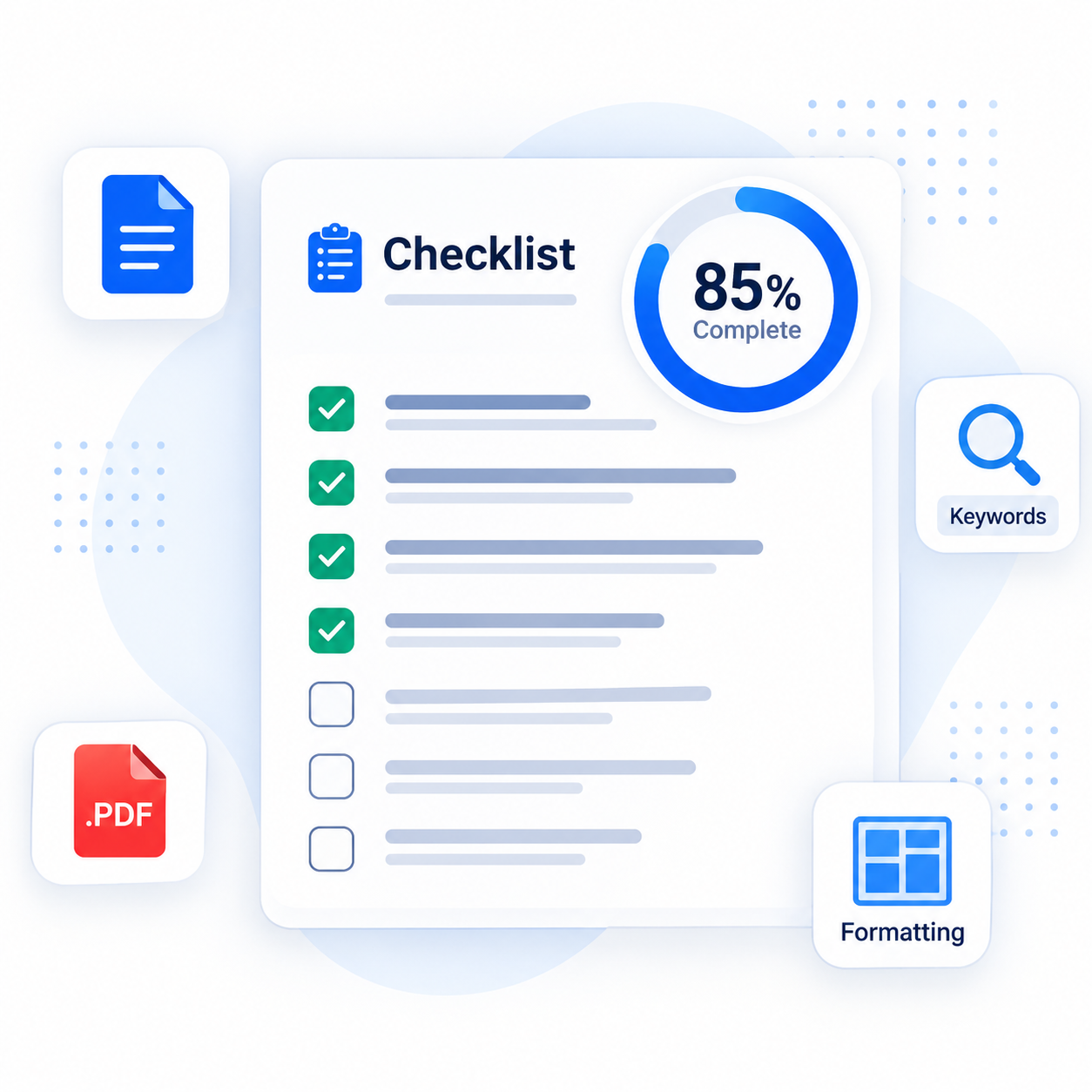
Before submitting your next application, run through this checklist:
- ⬜ Resume uses a clean, single-column layout with no tables or text boxes
- ⬜ File is saved as a text-based PDF (or DOCX if specifically requested)
- ⬜ Standard section headings are used: "Work Experience," "Education," "Skills," "Professional Summary"
- ⬜ Contact information is in the main body, not in the document header/footer
- ⬜ Skills section includes keywords from the target job description
- ⬜ Experience bullet points use relevant terminology from the posting
- ⬜ Achievements are quantified with numbers, percentages, or dollar amounts
- ⬜ Font is standard and legible (Arial, Calibri, Helvetica, Times New Roman)
- ⬜ No graphics, icons, images, progress bars, or logos
- ⬜ Resume has been tailored for this specific role
- ⬜ Spelling and grammar are error-free (especially technical terms)
- ⬜ Job titles are consistent and match industry standards
- ⬜ Resume has been tested with Resumetra or a similar ATS scanner
Conclusion
Your ATS score isn't a final verdict on your qualifications — it's an optimization tool that determines whether a recruiter ever gets the chance to evaluate them.
The candidates who consistently land interviews in 2026 aren't necessarily the most experienced or the most credentialed. They're the ones who understand how the hiring system works and optimize for it without losing their human voice.
Here's what to remember:
- ATS scoring is the first filter, not the final decision. Get past the machine, then impress the human.
- Balance optimization with readability. A resume that reads like a keyword dump will score well but convert poorly.
- Tailor every application. Generic resumes produce generic results.
- Test before you submit. Checking your score takes minutes. Waiting for a callback that never comes takes weeks.
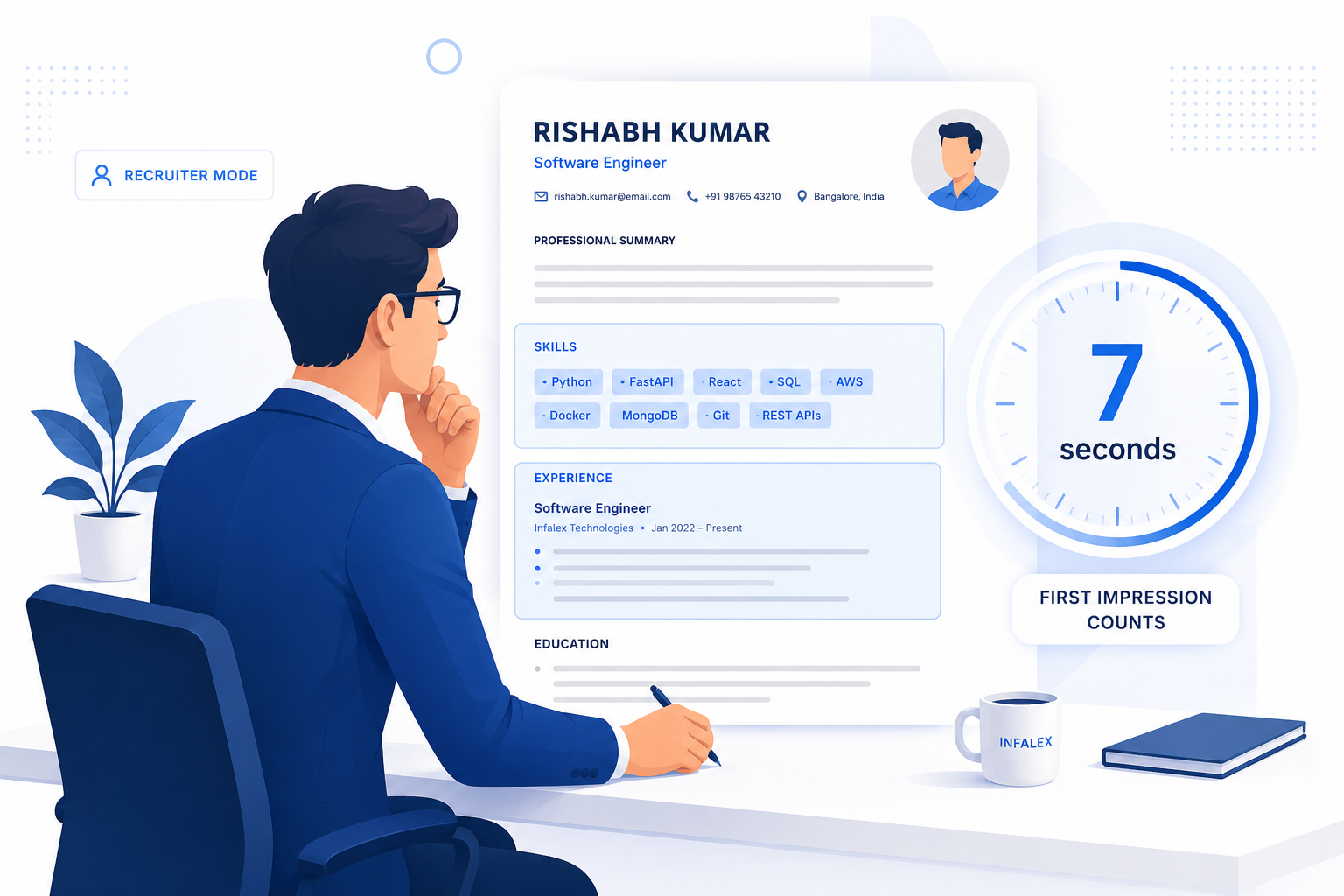
Your resume has about 6 seconds to make an impression on a recruiter — but it has even less time to impress the algorithm. Make both count.
💡 Infalex Insight:
Manually guessing whether your resume will pass an ATS is a gamble you don't need to take. Resumetra lets you upload your resume, paste the exact job description you're targeting, and get an instant ATS compatibility score — complete with missing keyword analysis, formatting checks, and skill gap identification. You'll know exactly where you stand before you hit "Apply." Stop guessing. Start optimizing.
🔗 Keep Optimizing Your Job Search with Infalex
If this guide helped you understand how ATS scores work, these related articles will take your resume strategy even further:
How to Create an ATS-Friendly Resume That Actually Gets Interviews — The complete step-by-step framework for building a resume that passes every ATS scan.
Stop Sending Your Resume Into a Black Hole: The 'Invisible' Formatting Mistake Rejecting Your Application — Uncover the hidden formatting errors that silently kill your applications.
Cracking the Code: Top Resume Keywords Recruiters Look for in 2026 — Discover the exact words and phrases that ATS algorithms and human recruiters prioritize.
Top 25 Resume Mistakes That Get You Rejected Instantly (And How to Fix Every Single One) — A comprehensive deep-dive into every resume error that costs you interviews.
The Ultimate Guide: Best ATS Resume Format for Freshers in 2026 — A step-by-step template guide built specifically for students and entry-level candidates.
How Long Should a Resume Be? The Definitive Guide (2026) — Finally settle the one-page vs. two-page debate with data-driven recommendations.
7 Resume Mistakes Costing You Job Interviews (And How to Fix Them) — A focused guide into the most costly resume errors and practical fixes for each one.
Frequently Asked Questions (FAQs)
Q: What is an ATS score?
A: An ATS score is a numerical ranking that indicates how closely your resume matches a specific job description. Applicant Tracking Systems generate this score by comparing the keywords, skills, experience, and formatting on your resume against the requirements listed in the job posting. Higher scores mean your resume is more likely to surface to the recruiter.
Q: Is 80 a good ATS score?
A: An 80% ATS score is generally considered a strong match. It means your resume aligns well with most of the job requirements. However, competitiveness depends on the applicant pool — if dozens of candidates score 85% or higher, you may still need to optimize further. Aim for 80% or above as a solid benchmark.
Q: Can ATS reject my resume automatically?
A: Not in the way most people think. ATS platforms typically rank and filter resumes rather than sending rejection emails. A low-scoring resume simply never surfaces in the recruiter's search results. However, some systems include knockout questions (e.g., "Do you have a valid work permit?") that can auto-disqualify candidates regardless of resume quality.
Q: How can I improve my ATS score?
A: Tailor your resume to each job description by including relevant keywords naturally in your experience and skills sections. Use a clean, single-column layout, standard section headings, and a text-based PDF format. Quantify your achievements with numbers. Before submitting, scan your resume with a tool like Resumetra to identify gaps.
Q: Which resume format is best for ATS?
A: A single-column, reverse-chronological format using standard headings ("Work Experience," "Education," "Skills") and a clean font like Arial or Calibri. Avoid multi-column layouts, tables, text boxes, and graphics. Save as a text-based PDF unless the job posting requests DOCX. For a complete formatting guide, read our ATS-friendly resume guide.
Q: Do all companies use ATS?
A: The vast majority do. Over 97% of Fortune 500 companies use an ATS, and adoption among mid-size and small businesses has grown significantly. Even startups commonly use lightweight ATS platforms like Greenhouse, Lever, or Workable. It's safest to assume every online application passes through an ATS.
Q: Does ATS read PDFs?
A: Yes — modern ATS platforms can read text-based PDFs without issue. The key distinction is between text-based PDFs (where you can highlight and copy text) and image-based or flattened PDFs (where the text is essentially a picture). Always ensure your PDF is text-selectable. Test by pressing Ctrl+A to select all text; if you can copy and paste it logically, the ATS can read it.
Q: Which resume checker is most accurate?
A: Accuracy varies, but the best resume checkers simulate actual ATS parsing rather than just counting keywords. Resumetra is designed to replicate how enterprise ATS platforms scan and score your document, giving you keyword analysis, formatting checks, and a precise compatibility score against your target job description.
Ready to optimize your career?
Join thousands of professionals using Infalex Resumetra to craft ATS-optimized resumes and land more interviews.